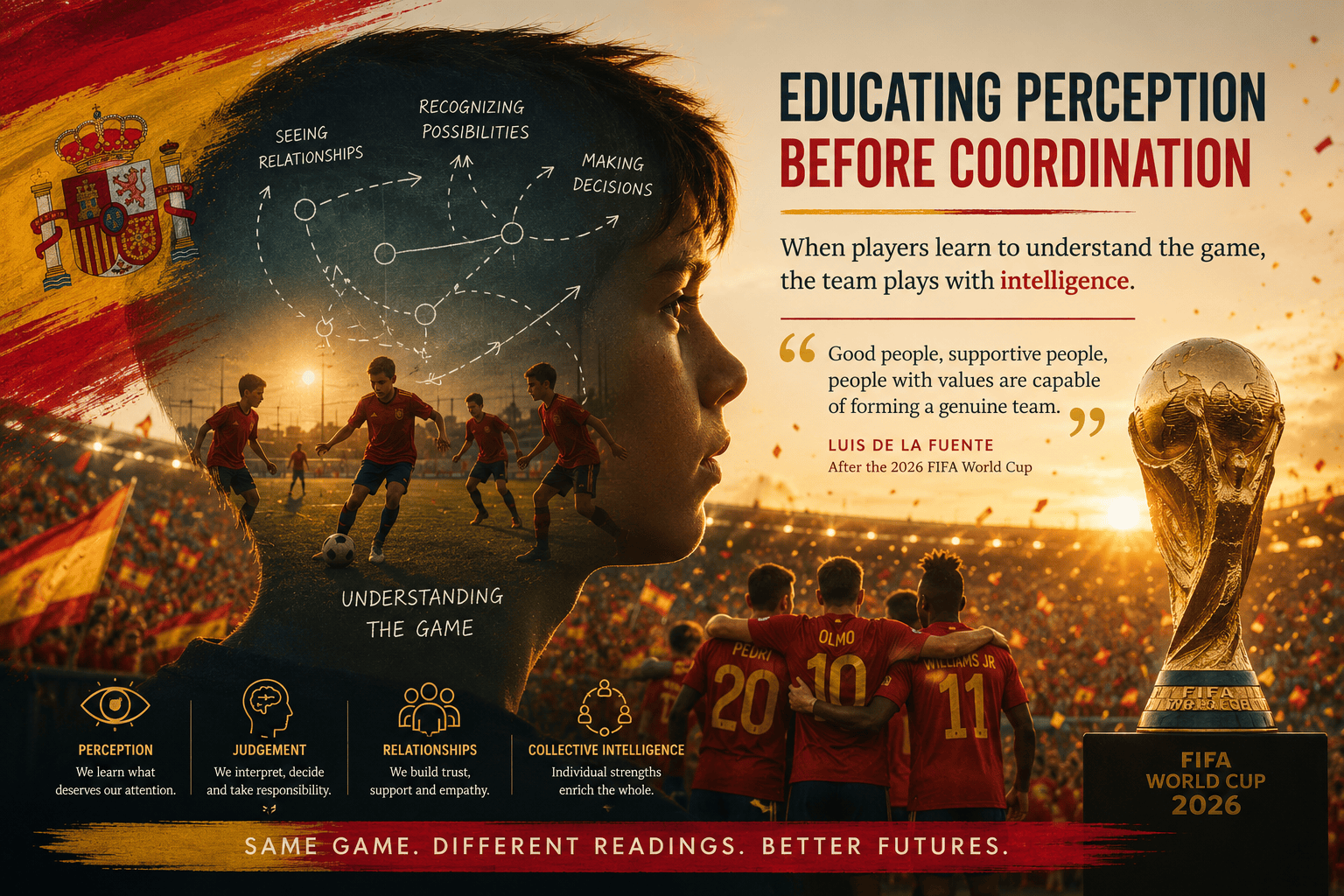
What if the greatest competitive advantage is not teaching people what to do, but teaching them what to notice?
When Spain lifted the 2026 FIFA World Cup, much of the immediate analysis focused on tactics, pressing systems, possession and individual brilliance. These visible elements matter. Yet a different question may tell us more about how sustained excellence is created: what kind of educational culture produces players capable of interpreting the game together, under pressure, as it changes around them?
That question reaches beyond football. Leaders face the same challenge whenever procedures no longer fit reality, circumstances evolve faster than plans, or a team must coordinate without waiting for instructions. In those moments, performance depends not only on skill or speed. It depends on perception.
One game, different readings
Football is a game of continuous interpretation. Every movement, pass and decision depends on how players perceive an evolving situation. The ball may be the same, the pitch identical and the rules shared, yet players experience the game differently because they have learned to notice different things.
Long before a player executes a pass, that player has already interpreted relationships, possibilities, risks and opportunities. Elite performance depends less on reacting quickly than on perceiving intelligently.
Spain and Argentina share an immense football heritage, a passion for the game and a vocabulary shaped by generations of players and coaches. Both speak of el juego, the game itself, as something that deserves respect and understanding. Yet in the final they appeared to read the same game through different interpretive traditions.
I use the word read deliberately. Reading is never passive. Two people can open the same book and discover different meanings because they attend to different details, connect different ideas and ask different questions. Football works in much the same way. Twenty-two players inhabit the same match, but each constructs a slightly different understanding of what is happening.
Every football culture develops habits of attention. It teaches young players where significance lies, which relationships deserve notice and which possibilities are worth exploring. Through repetition, these acts of attention become instinctive. Players no longer calculate every decision consciously because perception itself has been educated.
That may be one of the deepest forms of coaching: helping people enlarge what they are able to see.
A culture built through conversation
The evolution of Spanish football becomes particularly interesting when viewed through this lens. Its success appears less like the triumph of a single doctrine than the result of a long conversation about the nature of the game.
Over several decades, educators and thinkers such as José María Cagigal, Laureano Ruiz, Horst Wein, Paco Seirul·lo, Joan Vilà and Johan Cruyff challenged assumptions about player development. Their ideas circulated through coaching schools, academies, universities, professional clubs and the Spanish Football Federation. What emerged was not uniformity, but an enduring culture of inquiry.
This tradition did not produce identical coaches. Spanish football has generated managers with very different personalities and tactical preferences. What many share is deeper than a preferred formation: a language for thinking about perception, relationships, space, decision-making and understanding.
Communities of practice do not preserve knowledge by freezing it. They preserve it by interpreting it continually. Each generation inherits ideas, questions them, refines them and passes them forward. This may help explain how a culture can renew itself without abandoning its identity.
Educating perception before coordination
Tactics clearly matter. Every successful team demonstrates extraordinary organisation. The more interesting question concerns the sequence through which that organisation develops.
Spanish football appears to cultivate players capable of perceiving the game before asking them to coordinate within it. Technical mastery, awareness, decision-making and the recognition of relationships become foundations upon which tactical organisation can be built.
Seen in this light, tactics become less a system imposed from above and more a language emerging from shared understanding. When learning begins with perception, individuals become better able to interpret unfamiliar situations rather than reproduce familiar solutions. Coordination can then become an expression of collective intelligence because each participant contributes an active reading of the unfolding game.
The Spanish expression entendimiento del juego, understanding the game, captures this aspiration. Understanding is not the same as memorising instructions. It is the increasingly sophisticated ability to recognise meaningful patterns within complex situations and respond creatively alongside others.
Character before performance
Luis de la Fuente’s reflections after Spain’s victory reinforced this impression. His first instinct was not simply to celebrate tactics or individual talent. He spoke about the qualities of the people who formed the team: good people, supportive people and people with values, capable of becoming a genuine team.
The sequence matters. Character appears before performance. Relationships appear before systems. Trust becomes the soil from which collective excellence grows.
This suggests that football education reaches beyond technical competence. It concerns the formation of people capable of meaningful cooperation under pressure. Tactical and moral intelligence become intertwined because both depend on recognising relationships rather than pursuing individual success alone.
What this means for leaders and organisations
Organisations often attempt to improve performance by adding procedures, instructions and reporting. These can create clarity, but they can also weaken judgement when people learn to follow the map without reading the territory.
Leaders who want adaptive teams can work at a deeper level. They can develop the conditions in which people learn to notice what matters, interpret situations together and act responsibly when reality exceeds the script.
- Ask what people noticed before asking what they did. This reveals the perceptions behind decisions.
- Compare different readings of the same event. Productive disagreement can expand the team’s field of attention.
- Make feedback close and intelligible. People develop judgement when they can see the relationship between action and consequence.
- Create a shared language without demanding uniformity. Coordination improves when different perspectives can meet within a common frame.
- Treat character and relationships as part of performance. Trust is not an optional cultural benefit. It affects what a team can perceive and attempt together.
Every profession educates attention. Designers notice relationships that remain invisible to non-designers. Physicians recognise patterns within apparently unrelated symptoms. Experienced coaches hear emotional dynamics that others overlook. With experience, a complex environment may appear to slow down, not because events move more slowly, but because more possibilities become visible.
Perhaps this is the deepest achievement of any educational culture: it enlarges the world people are capable of seeing.
Beyond football
Spain’s victory can therefore be understood as more than a sporting accomplishment. It illustrates how long-term excellence grows from traditions that cultivate judgement, perception and shared understanding over many years.
Every organisation eventually faces the same choice. It can invest primarily in prescribing behaviours, or it can develop the perceptual and interpretive capacities that allow people to respond wisely when reality inevitably exceeds the script.
The first path creates competent execution. The second cultivates judgement.
The highest forms of collective intelligence may emerge when individuals have learned to perceive deeply, think independently and relate generously. Coordination then becomes more than organisation. It becomes the expression of people who have learned to read an unfolding reality together.
Questions for reflection
- What has your professional culture trained you to notice, and what might it be teaching you to overlook?
- When your team disagrees, are people defending positions or comparing different readings of reality?
- Does your organisation primarily prescribe behaviour, or does it cultivate judgement?
If these questions resonate with a challenge you are facing, you can learn more about my coaching approach or contact me for an introductory conversation.
An earlier version of this article was published on LinkedIn in July 2026.
 Frederick Dooley