What can a champion teach us about leadership? Not how to win every point, but how to keep learning when success, pressure and expectation all make change more difficult.
Jannik Sinner’s career is often described through talent, results and rankings. Those are visible. The more useful leadership lesson lies underneath: the way he combines agency, feedback and continuous improvement.
This is not a claim that sport and organizational life are identical. They are not. But elite performance makes certain dynamics easier to see. Pressure becomes concentrated. Feedback is immediate. Results are public. Under those conditions, the habits that sustain learning become especially clear.
Talent needs an environment that protects agency
After winning the 2024 Australian Open, Sinner spoke about the freedom his parents gave him to choose his own path. He had played several sports as a child, and they did not force a single identity onto him. He described that freedom as something he wished more young people could experience.
That detail matters because autonomy is not the opposite of discipline. It is often the condition that makes sustained discipline possible. When people experience a goal as partly their own, effort is less dependent on surveillance, approval or fear.
Leaders sometimes try to create commitment by increasing control. They specify every action, correct every deviation and make themselves the center of every decision. The immediate result may look orderly. The longer-term cost is weaker judgment: people become good at waiting for instructions.
A better environment combines direction with room to choose. Expectations can be clear while methods remain open to intelligent adaptation. The leadership question is not only, “Did I explain what to do?” It is also, “Does this person still feel responsible for the outcome?”
Improvement begins at the edge of comfort
Earlier in his career, Sinner described improvement as a willingness to leave the comfort zone. When challenges or defeats arrived, the response was to return to practice, understand what happened and try again with better information.
This sounds simple, but it contains an important distinction. A disappointing result can become a verdict on identity, or it can become data. The first response produces defensiveness. The second creates movement.
Development accelerates when we can examine a result without turning it into a judgment about our worth.
In organizations, the same distinction determines whether feedback leads to learning. If every mistake threatens status, people hide uncertainty and protect their image. If a team can separate the person from the performance, it can ask more useful questions: What did we expect? What actually happened? Which assumption failed? What will we test next?
Pressure is not removed, it is interpreted
After defending his Australian Open title in 2025, Sinner did not present success as a finished state. He spoke about handling different situations, studying how Novak Djokovic managed decisive moments, and continuing to improve on other surfaces. His phrase was direct: “I can do better.”
The lesson is not endless dissatisfaction. Healthy ambition is different from refusing to acknowledge progress. The useful balance is to recognize what worked without allowing success to close the learning process.
Pressure also changes when we interpret it as evidence that something matters, rather than proof that something is wrong. Leaders cannot eliminate uncertainty from serious work. They can help people convert it into attention: What is controllable now? Which decision has the greatest leverage? What does the situation require, rather than what does my anxiety demand?
A strong team extends intelligence
Sinner’s coach Simone Vagnozzi has emphasized both his mental strength and his ability to listen, process advice and apply it. This is a valuable picture of collaboration. Coaching is not passive obedience. It works when expertise from the outside meets judgment and responsibility on the inside.
The same is true in leadership teams. The goal is not to create dependence on the person with the highest title. It is to distribute perception. One colleague may see a customer risk, another a pattern in the data, another a human consequence that the group has overlooked. A capable leader makes those signals easier to contribute and combine.
Listening, in this sense, is not politeness. It is a performance capability. It allows a person to update faster than someone who must always defend the original position.
Five practices leaders can borrow
- Protect agency. Be explicit about the outcome and constraints, then leave meaningful room for judgment.
- Separate identity from results. Review performance rigorously without turning a setback into a verdict on the person.
- Convert feedback into a next action. A useful review ends with a concrete experiment, not only an explanation.
- Keep success open. Name what worked, then ask which capability the next context will require.
- Use pressure to narrow attention. Return to what can be influenced now, especially when the wider situation feels uncontrollable.
Questions for reflection
- Where am I giving direction, but unintentionally removing ownership?
- Which recent result am I treating as a judgment instead of information?
- Whose perspective could improve my next decision?
- What is the smallest useful adjustment I can make now?
- After a success, what must remain unfinished?
Sinner’s example is compelling because improvement is not presented as a dramatic reinvention. It is a continuing practice of noticing, listening and adjusting. Talent may create possibility. Awareness and disciplined action make that possibility repeatable.
Sources and further reading
- Australian Open: “The kids are alright: Wise heads on young shoulders”
- Australian Open: “Sinner: I’m very happy I chose”
- Australian Open: “I can do better: Sinner aims higher after men’s final masterclass”
- Corriere della Sera: Simone Vagnozzi on Sinner’s ability to listen, learn and improve
Continue exploring
Focus on What You Can Influence
How attention becomes agency when complexity cannot be controlled.
Spain, the World Cup, and Educating Perception
What collective intelligence in sport can teach us about leadership.
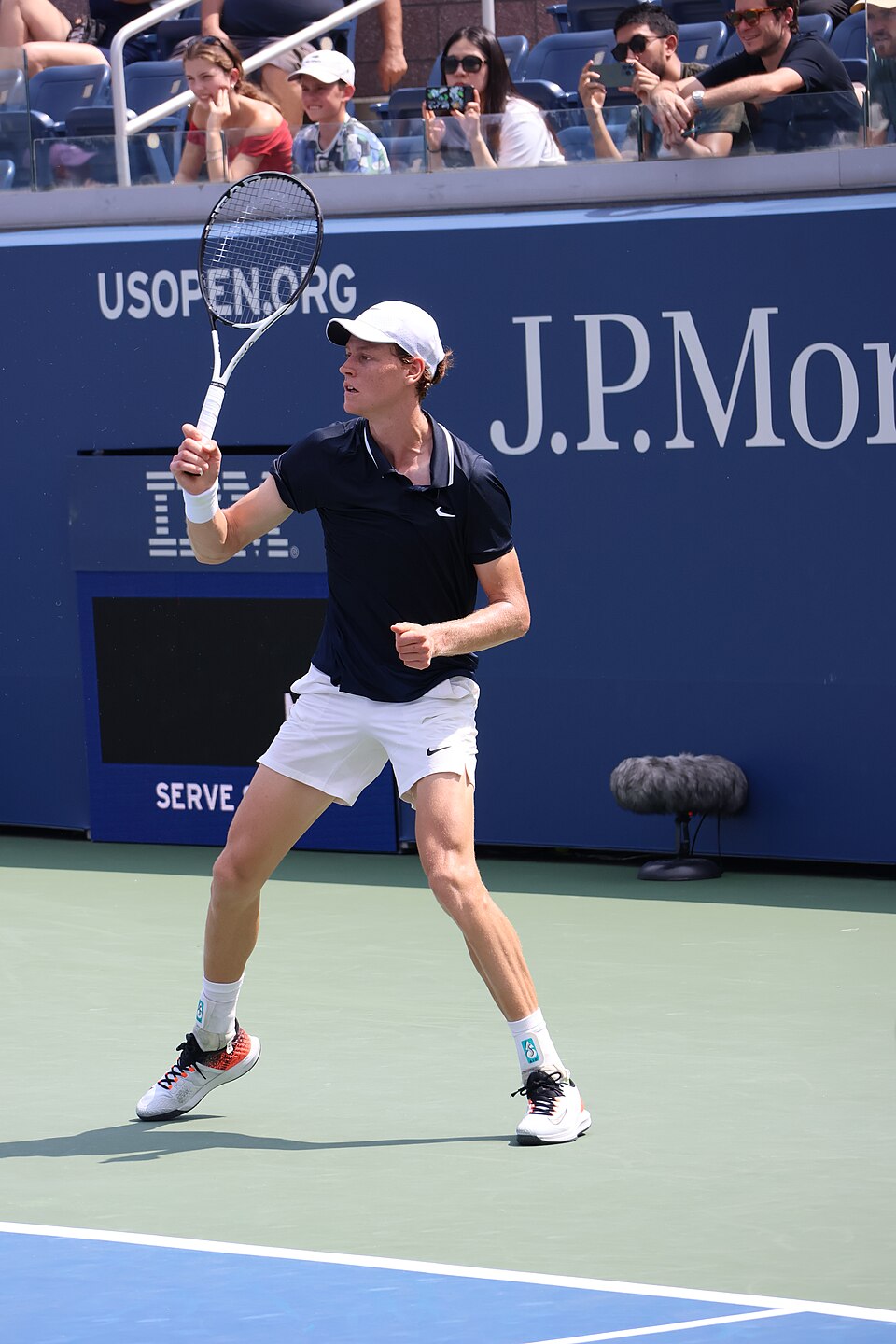
Featured image: Jannik Sinner at the 2024 US Open. Photo: Hameltion / Wikimedia Commons, CC BY-SA 4.0.
This article develops and updates an earlier version published on LinkedIn in December 2024.
Discover more from Frederick Dooley
Subscribe to get the latest posts sent to your email.

